
The modern MNC, the transformation of global work, and the reconceptualisation of distance: 10 years of IB research at Loughborough University London

Since its inception in 2017, the International Management & Entrepreneurship Group at Loughborough University London has sought to contribute to the endeavour of making international business studies fit for the 21st century. For a long time, IB studies relied on rather crude concepts that have become increasingly inadequate to capture the reality of a complex and fast-changing world.
Previous work by IMEG scholars has shown that the transformation of the ways people collaborate in modern MNCs challenges the very notion of a ‘subsidiary’. Given that MNCs organise their work across flexible and constantly changing international teams whose members are spread over various countries and interact often primarily or exclusively through telecommunication tools, the basic IB idea that MNCs are organised into headquarters and overseas subsidiaries with country managers and clear reporting lines seems increasingly outdated. Similarly, the idea that internationalisation of economic activity happens from the top – through decisions made by C-suite executives – misses the fact that within the modern MNC a whole range of actors’ daily work involves international contacts and activities, turning such mid- and lower-level employees into “globalising actors”.
In our latest research we further explore these transformations of the modern MNC and argue that they suggest the need to reconceptualise another concept at the heart of IB research: institutional distance. This idea draws our attention to the fact that countries differ not just in terms of resource endowments, market characteristics, or cultural aspects, but also in terms of the humanly-devised ‘rules of the game’ that shape interactions between economic actors. However, institutional distance is based on questionable implicit assumptions. Most importantly, it is treated as a country-level concept that equally applies to all multinational corporations (MNCs) from one country active in another - convenient from a research perspective, but increasingly untenable.
Our just-published paper Institutional Distance and the Lived Experience of Actors in the Contemporary MNC: The Role of Positionality, co-authored with Johann Fortwengel from King’s College London, draws on insights from international HRM to challenge this problematic assumption. We make the case that institutional distance cannot be adequately captured through the difference in objective measures of two countries, but needs to be understood as a subjective phenomenon. As previous work of IMEG researchers has shown, subjective perception-based measures of institutional features – such as the quality of law – are often better at predicting outcomes than the more common objective, country-level ones. Just like other institutional features, institutional distance is in the eye of the beholder.
We draw on the notion of actors’ ‘positionality’ within the MNCs to develop a framework that allows us to think about this subjective perception of institutional distance. We distinguish three dimensions of positionality. Firstly, the extent to which an MNC employee’s experience in the host country is holistic versus partial; secondly, the extent to which it is enduring versus transitory; thirdly the extent to which it is direct versus mediated (see figure 1 below).
For instance, an expatriate senior manager will have a holistic appreciation of a country’s institutional context, because during their tenure in the country they will experience a wide range of institutional features going way beyond the institutions that matter for their day-to-day job. They will also have an enduring and direct experience of these institutional features, because they are present in the country for a long time. Conversely, a global virtual team leader may have a relatively enduring experience of a host countries institutions – if they remain in post for some time – but the experience will be partial (primarily focused on those institutions that affect the role in question) and mediated (country-specific experiences will primarily be shared by co-workers present in the host country, not directly lived).
These dimensions of actors’ positionality will determine how they perceive institutional distance, which therefore should be conceived of as a concept that varies not just across firms, but indeed across employees of the same firm.
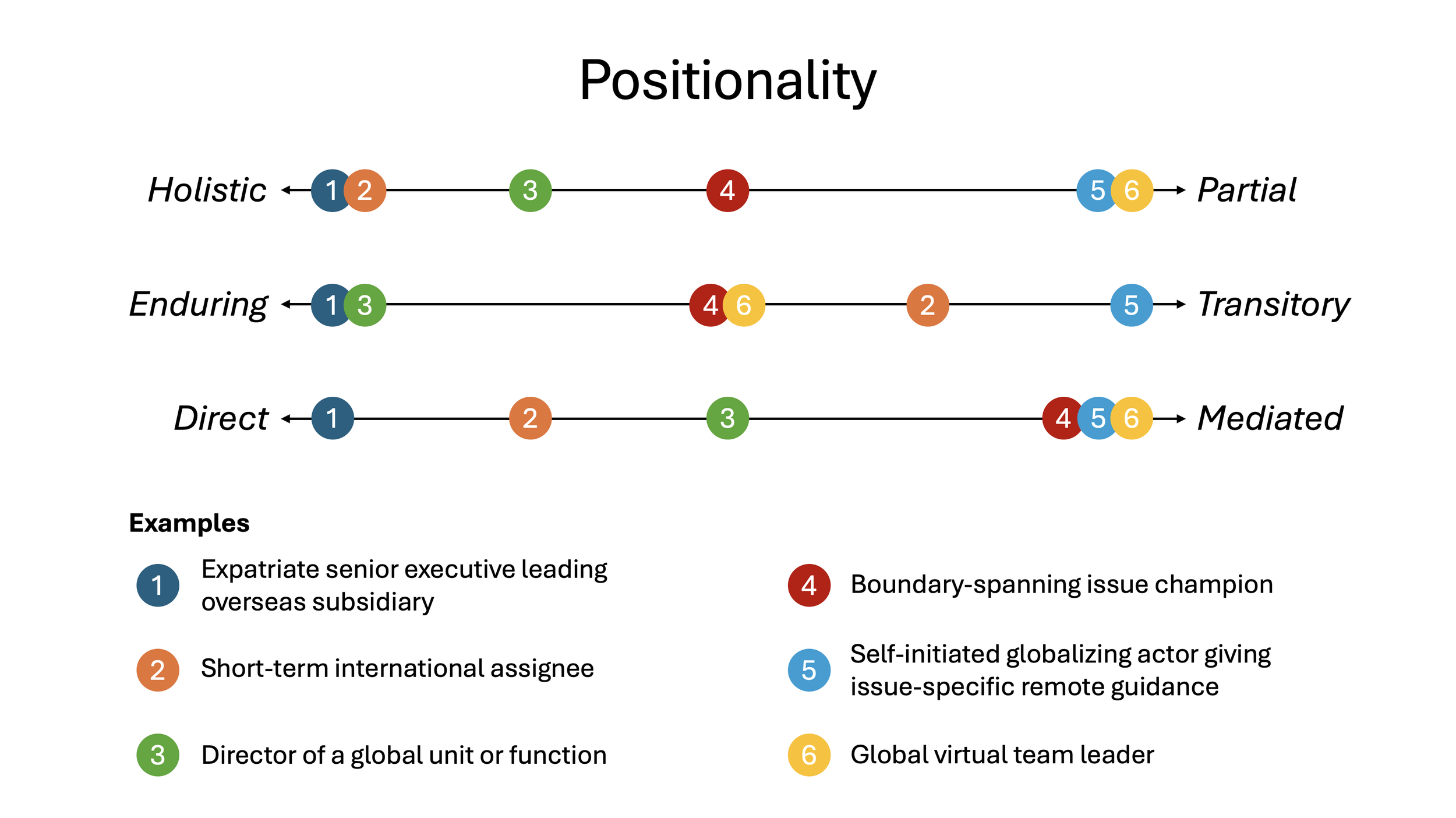
Figure 1
We further argue that actors’ positionality determines how they judge institutional distance on three dimensions (see figure 2). Namely, whether the host countries’ institutions are similar and equivalent to the home country’s (in terms of providing institutionally-shaped input factors); whether they are encompassing or non-encompassing, i.e. unevenly spread across the host country’s territory; and whether they are malleable or non-malleable, i.e. within the company’s capacity to influence and shape through the MNCs’ non-market strategy.
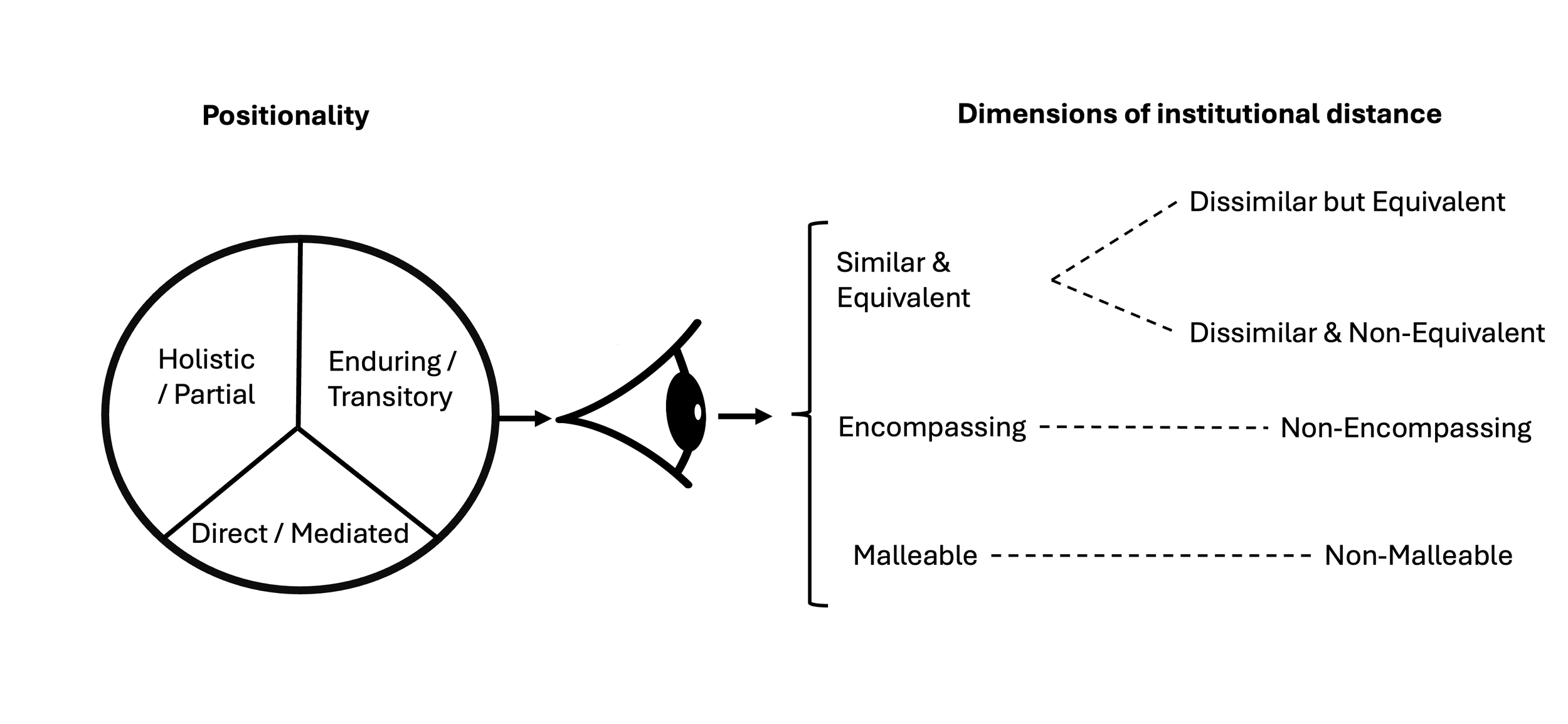
Figure 2
Arguably, our re-conceptualisation of institutional distance raises as many questions as it answers. Indeed, our novel way of conceptualising distance as a subjective phenomenon – as the original Uppsala model actually also did – opens up a host of new venues for research. Most importantly, perhaps, while we focus on dimensions of positionality related to an employee’s position in the organisational structure and their job role, positionality also varies along characteristics like race, gender, and age. Our framework therefore lends itself to extensions into new areas and to making important connections with current debates about cross-cultural management and DEI.
Having recently celebrated the 10th anniversary of Loughborough University London, IMEG continues to develop these ideas into new directions to generate an ambitious and impactful research programme to understand modern international businesses and their context.
