
Blog
In-depth coverage of IMEG research projects, noteworthy publications, and new ideas.

Michael Mann’s Sources of Power in the Era of Global Fragmentation
Is the United States a rogue empire? This was the question at the heart of Prof Michael Mann's recent talk at Loughborough University London. As the author of the landmark four-volume The Sources of Social Power and one of the most influential theorists of power, Professor Mann offered a sharp diagnosis of where American foreign policy is heading and why its direction should worry us all.
Melike Bozkurt and Arbnor Bajraliu
Is the United States a rogue empire? This was the question at the heart of Michael Mann's recent talk at Loughborough University London. As the author of the landmark four-volume The Sources of Social Power and one of the most influential theorists of power, Professor Mann offered a sharp diagnosis of where American foreign policy is heading and why its direction should worry us all. For those of us trying to make sense of an increasingly unstable world’s geopolitical and geoeconomic dynamics, his arguments were hard to ignore.
Professor Michael Mann
Professor Mann’s four-volume The Sources of Social Power - spanning from neolithic times[i] to 2011[ii] - traces how ideological, economic, military and political power have interacted to shape human societies. Rather than treating society as a single unified system, he sees it as a series of overlapping and intersecting power networks each with its own logic and trajectory. This framework has guided a remarkably wide-ranging body of his work: Fascists (2004)[iii], The Dark Side of Democracy: Explaining Ethnic Cleansing (2012)[iv], and Incoherent Empire (2003)[v], among others. His most recent book, On Wars (2025)[vi] , argues that wars rarely result from rational calculation but reflect the ideologies, emotions and miscalculations of a handful of political leaders. It was with this extensive work behind him that Mann turned his attention to Trump.
In his talk, Rogue Empire: Trump's Wars, Mann provides a good explanation on why he considers the US today a “Rogue Empire” rather than an “Incoherent Empire”, as he described decades ago. The key reason for this label is Trump's personality and the way he transformed the American state into a personal tool for power. According to Mann, Trump's rise was due to a combination of different structural issues, such as the urban-rural divide, the decline of manufacturing, and the rise of the right-wing politics, which created the condition for a president who bypasses expert advice and pursues a foreign policy defined by short-sightedness and aggression.
His other argument was that Trump’s escalation toward war followed a deliberate pattern, even if his methods looked chaotic. These included the abandonment of treaties and international agreements in the beginning, as well as the use of tariffs as a weaponisation tactic, a zero-sum logic, and finally military actions, first in Venezuela and then Iran. He followed one key lesson learned from the past: no boots on the ground. Instead, he relied on targeted strikes against the adversary leaders and strategic targets, trying not to risk American lives. Venezuela was an example, but Mann pointed out that this worked only because Venezuela lacked the capacity to sustain meaningful resistance. The same cannot be said about Iran.
Trump expected Iran to surrender, but instead he faced a resistance which exposed the limits of his strategy. Iran’s deeply embedded religious identity, resilient institutions with an established logic of succession[vii], and the military capacity of the Islamic Revolutionary Guard Corps (IRGC)[viii] proved harder to break than anticipated. When the leaders were eliminated, the IRGC kept its strongest weapon, control of the Strait of Hormuz[ix], where about twenty per cent of global oil and gas passes through. Going back to his four sources of power and linking them to this war, it meant that the US had an economic and military edge over Iran, but the same cannot be said about its ideological or political power.
What strikes us as international political economy (IPE) researchers, having studied economic interdependencies and how they become tools of statecraft, is that Mann also points out something which is larger than Trump: The Strait of Hormuz. This is a clear example of what happens when economic interdependence gets weaponised. The US can impose tariffs and sanctions, but Iran was able to cut off a chokepoint on which the global economy relies. A global economy that, over the recent decades, focused on the efficiency of supply chains is now disrupted and fragmented around geopolitical lines. A once mutually beneficial, integrated global economy is now becoming a liability to be managed. Reconfiguration of production lines, stockpiling of critical minerals, friendshoring, and re-industrialisation are some of the strategies that states and private actors are using to bring back the control of supply chains. The control of connections of global production networks is becoming a source of power in itself.[x]
Yet the question of who gets to control these connections is neither simple nor settled. The answer depends not only on economic power but on how states position themselves across all four of Mann’s sources of power - economically, politically, militarily and ideologically - in a rapidly changing international order. Iran’s resistance to the US illustrates this well: A non-hegemonic state with limited economic and military resources was able to impose real costs on a hegemon[xi] precisely because it retained ideological power and political control over a critical economic node. Whether other states can draw similar leverage from their own position remains an open question[xii]. However, what Mann’s framework makes clear is that in a world where all four sources of power are being contested, the cost of being caught unprepared might be higher than ever.[xiii]
This may be a moment of strategic recalibration for non-hegemonic powers in an increasingly multipolar world.[xiv] States in non-hegemonic powers are increasingly intervening in their own economies, shielding strategic industries from foreign competition, directing investment into critical technologies and selectively disengaging from supply chains that leave them exposed.[xv] Yet this is not simply a defensive posture. They can also be instruments of opportunity, allowing states to reposition themselves as alternative hubs, critical suppliers or important partners in a reconfiguring global order.[xvi] Whether these strategies of economic statecraft ultimately enhance the state’s strategic autonomy or simply redirect its dependencies toward other hegemonic powers remains, for now, an open question.
Professor Michael Mann’s visit left us with a shaper sense of how quickly the ground is shifting and how much is still unknown. Whether Trump’s America represents a rupture in the international order or an acceleration of long-standing tendencies is a question Mann’s own framework cannot fully resolve. Because, as he reminds us, power is never driven by a single source, there are contingencies in the four sources of power, and its consequences are rarely what anyone intended. What seems clear is that the international order is being remade along new lines of power and dependence and the costs of that transition will not be shared equally.
Watch the Recording
Part 1 - Talk by Prof Michael Mann at LUL on 28 April 2026
Part 2 - Talk by Prof Michael Mann at LUL on 28 April 2026
Part 3 (Q&A) - Talk by Prof Michael Mann at LUL on 28 April 2026
References
[i] Mann, Michael. 1986. The Sources of Social Power: Volume 1, A History of Power from the Beginning to AD 1760. 1st ed. Cambridge University
[ii] ___.2012a. The Sources of Social Power: Volume 4, Globalizations, 1945-2011. 1st ed. Cambridge University Press.
[iii] ___.2004. Fascists. 1st ed. Cambridge University Press
[iv] ___.2012b. The Dark Side of Democracy: Explaining Ethnic Cleansing. 1st ed. Cambridge University Press.
[v] ___.2003. Incoherent Empire. Verso Books.
[vi] ___.2025. On Wars. Yale University Press.
[vii] Jalabi, R. 2026. “A Brief Guide to Iran's Complex Regime.” Financial Times, February 28, 2026. https://www.ft.com/content/44edd1b7-7b28-4b38-b30e-6607e4b148d7
[viii] Izadi, R. 2026. “The War with Iran Made the IRGC Stronger.” Journal of Democracy, April 2026. https://www.journalofdemocracy.org/online-exclusive/the-war-with-iran-made-the-irgc-stronger/
[ix]BBC News. 2025. “Why the Strait of Hormuz Matters So Much in the Iran War.” BBC News, June 23, 2025. https://www.bbc.co.uk/news/articles/c78n6p09pzno
[x] Bajraliu, A., 2025. US and China Sourcing in High-Tech Components – Geopolitical Alignment as a Way to Achieve GVC Domination. Krakow, EISA.
[xi] Byman, D. 2026. “Who Is Winning the Iran War?” Center for Strategic and International Studies, April 2, 2026. https://www.csis.org/analysis/who-winning-iran-war
[xii] Dalacoura, K., T. Dodge, P. Trubowitz, and S. Vakil. 2026. “The Geopolitical Implications of the Israel-US-Iran War.” Panel discussion, Middle East Centre, London School of Economics and Political Science, March 17, 2026. https://www.lse.ac.uk/lse-player/the-geopolitical-implications-of-the-israel-us-iran-war
[xiii] Batmanghelidj, E. 2026. “The Iran War Is Jeopardizing the Entire Global Economy.” Foreign Policy, March 4, 2026. https://foreignpolicy.com/2026/03/04/iran-war-dubai-saudi-qatar-global-economy-oil-shipping-trade/
[xiv] Apaydin, F., M. Sancak, and A. Nölke. 2026. “Introduction to Special Issue: Bridging Comparative and International Political Economy for the Study of Industrial Policy beyond the Hegemons.” Journal of Economic Policy Reform.
[xv] Bozkurt, M. and H.E. Karaoguz. 2026. “Defying the Odds: A Political Economy Analysis of Turkey’s Defence Industry within the Systemic Vulnerability Framework.” Journal of Economic Policy Reform.
[xvi] Bozkurt, M., G. Schnyder, and M. Sancak. 2025. “Middlepowerness and (Mis)Alignment between Economic Statecraft and Industrial Policy: The Solar Industry in India and Turkey.” Paper presented at the European Workshop on International Studies (EWIS), Kraków, July 2-4

The modern MNC, the transformation of global work, and the reconceptualisation of distance: 10 years of IB research at Loughborough University London
Since its inception in 2017, IMEG has sought to contribute to the endeavour of making international business studies fit for the 21st century. Our work has challenged common, yet increasingly untenable assumptions that underly IB research, including the role of national subsidiaries, how MNCs coordinate their cross-border activities, and the quality of law. In a just-published paper, we apply these insights to the idea of institutional distance and suggest that it needs to be reconceptualised as a subjective phenomenon based on the lived experience of managers.
Since its inception in 2017, the International Management & Entrepreneurship Group at Loughborough University London has sought to contribute to the endeavour of making international business studies fit for the 21st century. For a long time, IB studies relied on rather crude concepts that have become increasingly inadequate to capture the reality of a complex and fast-changing world.
Previous work by IMEG scholars has shown that the transformation of the ways people collaborate in modern MNCs challenges the very notion of a ‘subsidiary’. Given that MNCs organise their work across flexible and constantly changing international teams whose members are spread over various countries and interact often primarily or exclusively through telecommunication tools, the basic IB idea that MNCs are organised into headquarters and overseas subsidiaries with country managers and clear reporting lines seems increasingly outdated. Similarly, the idea that internationalisation of economic activity happens from the top – through decisions made by C-suite executives – misses the fact that within the modern MNC a whole range of actors’ daily work involves international contacts and activities, turning such mid- and lower-level employees into “globalising actors”.
In our latest research we further explore these transformations of the modern MNC and argue that they suggest the need to reconceptualise another concept at the heart of IB research: institutional distance. This idea draws our attention to the fact that countries differ not just in terms of resource endowments, market characteristics, or cultural aspects, but also in terms of the humanly-devised ‘rules of the game’ that shape interactions between economic actors. However, institutional distance is based on questionable implicit assumptions. Most importantly, it is treated as a country-level concept that equally applies to all multinational corporations (MNCs) from one country active in another - convenient from a research perspective, but increasingly untenable.
Our just-published paper Institutional Distance and the Lived Experience of Actors in the Contemporary MNC: The Role of Positionality, co-authored with Johann Fortwengel from King’s College London, draws on insights from international HRM to challenge this problematic assumption. We make the case that institutional distance cannot be adequately captured through the difference in objective measures of two countries, but needs to be understood as a subjective phenomenon. As previous work of IMEG researchers has shown, subjective perception-based measures of institutional features – such as the quality of law – are often better at predicting outcomes than the more common objective, country-level ones. Just like other institutional features, institutional distance is in the eye of the beholder.
We draw on the notion of actors’ ‘positionality’ within the MNCs to develop a framework that allows us to think about this subjective perception of institutional distance. We distinguish three dimensions of positionality. Firstly, the extent to which an MNC employee’s experience in the host country is holistic versus partial; secondly, the extent to which it is enduring versus transitory; thirdly the extent to which it is direct versus mediated (see figure 1 below).
For instance, an expatriate senior manager will have a holistic appreciation of a country’s institutional context, because during their tenure in the country they will experience a wide range of institutional features going way beyond the institutions that matter for their day-to-day job. They will also have an enduring and direct experience of these institutional features, because they are present in the country for a long time. Conversely, a global virtual team leader may have a relatively enduring experience of a host countries institutions – if they remain in post for some time – but the experience will be partial (primarily focused on those institutions that affect the role in question) and mediated (country-specific experiences will primarily be shared by co-workers present in the host country, not directly lived).
These dimensions of actors’ positionality will determine how they perceive institutional distance, which therefore should be conceived of as a concept that varies not just across firms, but indeed across employees of the same firm.
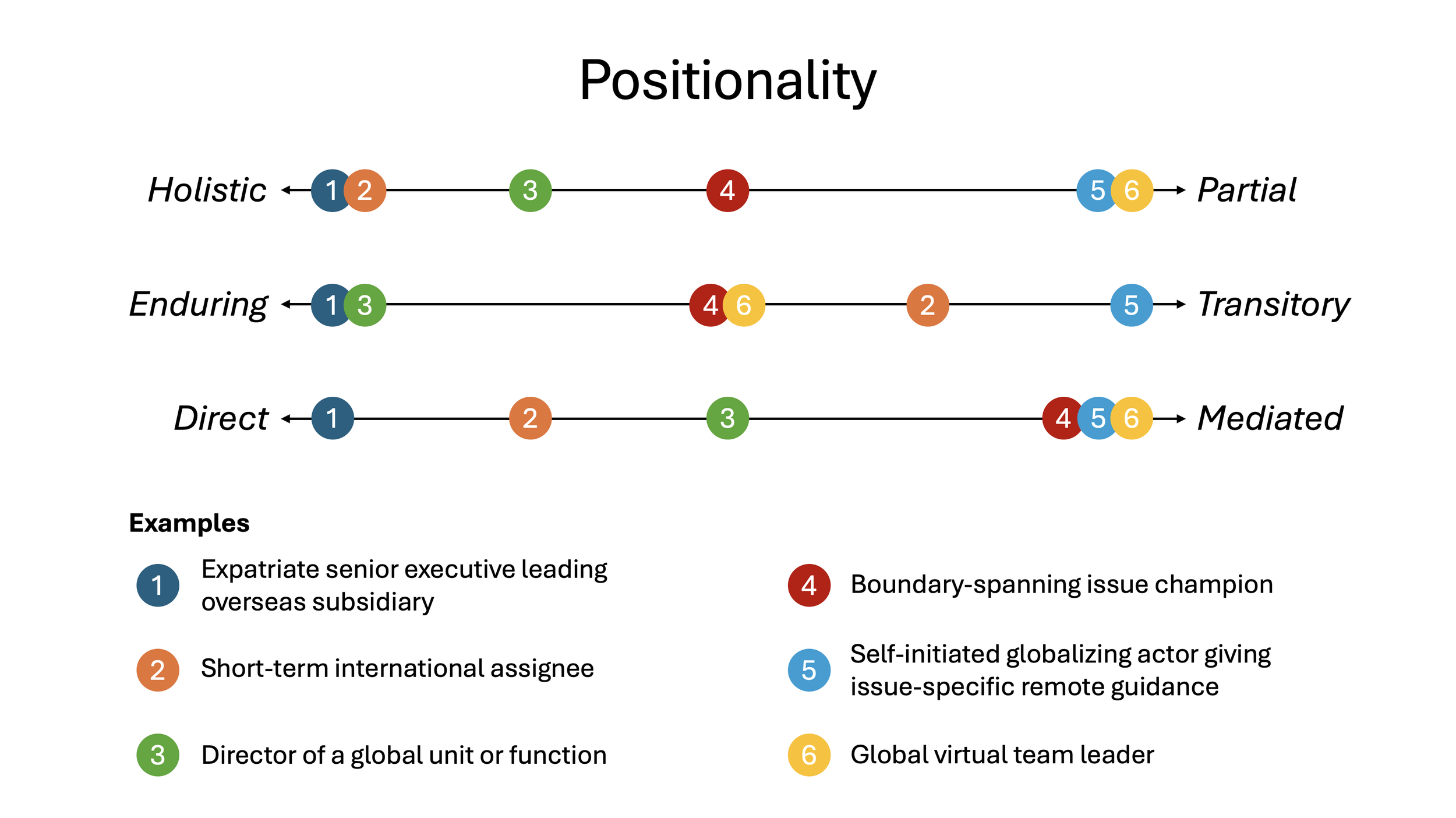
Figure 1
We further argue that actors’ positionality determines how they judge institutional distance on three dimensions (see figure 2). Namely, whether the host countries’ institutions are similar and equivalent to the home country’s (in terms of providing institutionally-shaped input factors); whether they are encompassing or non-encompassing, i.e. unevenly spread across the host country’s territory; and whether they are malleable or non-malleable, i.e. within the company’s capacity to influence and shape through the MNCs’ non-market strategy.
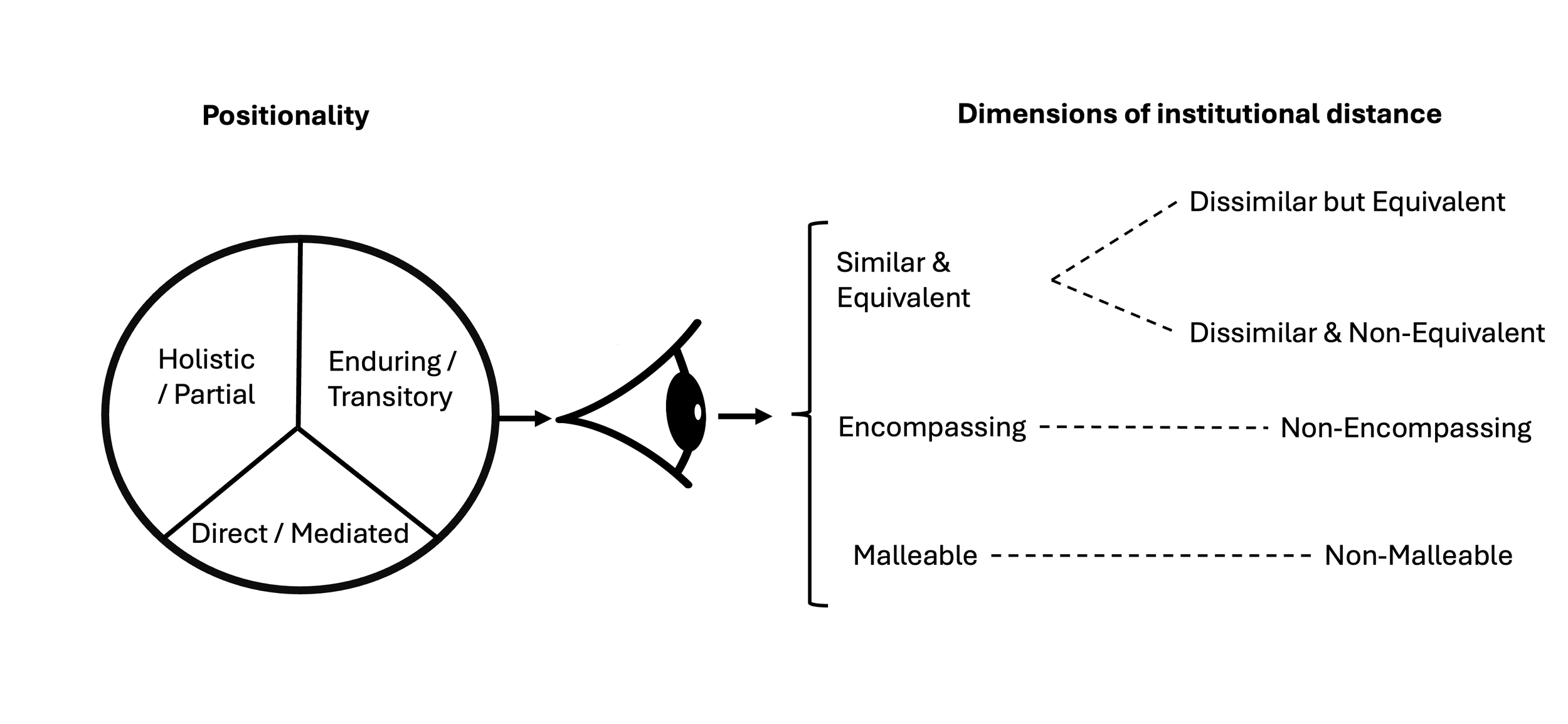
Figure 2
Arguably, our re-conceptualisation of institutional distance raises as many questions as it answers. Indeed, our novel way of conceptualising distance as a subjective phenomenon – as the original Uppsala model actually also did – opens up a host of new venues for research. Most importantly, perhaps, while we focus on dimensions of positionality related to an employee’s position in the organisational structure and their job role, positionality also varies along characteristics like race, gender, and age. Our framework therefore lends itself to extensions into new areas and to making important connections with current debates about cross-cultural management and DEI.
Having recently celebrated the 10th anniversary of Loughborough University London, IMEG continues to develop these ideas into new directions to generate an ambitious and impactful research programme to understand modern international businesses and their context.

Varieties of Media Vandalism
The biggest threat to the nationalist populist project in its various flavours – authoritarian, libertarian, illiberal – are well informed citizens. Therefore, it comes as no surprise that quality media outlets are one of the main targets of national populists of various stripes. The Financial Times’s Edward Luce recently called Jeff Bezos’ ‘management’ of the Washington Post ‘calculated vandalism.’ Vandalism is a useful way of describing how nationalist populists try to shape national mediascapes in their favour. However, there seem to be at least three variations on the theme of populist media vandalism.
The biggest threat to the nationalist populist project in its various flavours – authoritarian, libertarian, illiberal – are well informed citizens. Therefore, it comes as no surprise that quality media outlets are one of the main targets of national populists of various stripes. The Financial Times’s Edward Luce recently called Jeff Bezos’ ‘management’ of the Washington Post ‘calculated vandalism.’ Vandalism is a useful way of describing how nationalist populists try to shape national mediascapes in their favour. However, there seem to be at least three variations on the theme of populist media vandalism.
In the US case, Luce described Jeff Bezos’ approach to the Post in the following way:
‘[R]eviving the Post is evidently not Bezos’s objective. His goal seems to be to convert what Donald Trump used to call the “Amazon Washington Post” into a harmless shell of its former self as a display of knee-bending.’
Other examples of ‘pro-Trump oligarchs’ (Luce’s words) who have taken control of US media outlets to vandalise them include Elon Musk – who took over the social media platform Twitter and essentially turned it into a cesspit of misinformation and online hatred – and the Ellison family who among other things acquired the CBS network and used their control to undermine its ‘courage journalism’ and instead adopt a resolutely pro-Trump line according to Luce.
These examples illustrate that in the US media vandalism from far-right figures takes a plutocratic form. Super-rich individuals or families buy up quality media outlets and essentially run them into the ground, by successive waves of restructuring, firing journalists, and undermining any critical reporting. This plutocratic variety of media vandalism may be a reflection of the country’s hugely inequal wealth distribution and the existence of obscenely rich billionaires. Other contexts seem to give rise to other forms of media vandalism.
In some countries where nationalist populist have a solid grip on power, they use the levers of state power – rather than merely private wealth – to bring the media under control and vandalise them. Probably the most striking case is Victor Orban’s Hungary, which we studied for our Norface-funded POPBACK project. Orban – Hungarian Prime Minister since 2010 – has used various levers of power to reshape the mediascape. The state has revoked radio licences and Orban allies have been buying up newspapers, radio- and TV stations to then donate them to the Central European Press and Media Foundation (KESMA in Hungarian). As a result, an estimated 80% of the media in Hungary are aligned with Orban, which dramatically enhances his chances of winning yet another Parliamentary election in April.
Hungary may be the most extreme but by far not the only case of right-wing populists using their control over the state to reshape the mediascape (See our comparative study of Austria, Hungary, Slovenia, and Turkey in Media, Culture, and Society here).
These are two rather radical varieties of media vandalism which presuppose considerable economic- or political power concentration respectively. More subtle forms of media vandalism can be observed where democracy is still functioning to some extent and where nationalist populist power is more diffuse.
In such cases, the first target of nationalist populist media vandalism tends to be public broadcaster. During the Tories right-wing populist phase, the BBC has come under sustained political pressure both from outside and from the inside. From the outside, a constant barrage of accusations of ‘left-wing bias’ has sought to undermine the corporation’s credibility and reputation for quality journalism and entertainment (the reality seems to be quite a different one). From the inside, the role of Sir Robbie Gibb – former communications director of conservative PM Theresa May – as member of the BBC Board – appointed by Boris Johnson – has been particularly controversial. Star-journalist Emily Maitlis denounced Gibb - who also helped co-found far-right TV station GB News – as an ‘agent of the Tory party’ on the BBC board who influenced the reporting of journalists. She cited him as a reason for her leaving the BBC in 2019. Several other high-profile journalists left the BBC, while politically aligned ones – such as arguably Laura Kuenssberg – got promoted to prominent positions.
Another tool of media vandalism targeted at public broadcasters are attacks on licence fees. In Switzerland, the far-right Swiss People’s Party – a party with sympathies for Donald Trump – has launched an initiative to cap the Swiss Broadcast Corporation’s licence fee at CHF200 – a cut by nearly half from the current level. A popular referendum will take place on March 8, 2026. If successful, the initiative – which would not allow the SBC to compensate the reduction in fee income with additional advert income – would lead to redundancies and undermine the provision of quality news accessible to everyone.
Such attempts to vandalise quality journalism are often motivated by a mixture of economic and political objects. Economically, the destruction of public broadcasters would create more space for Fox-News-style private challengers – such as GB News in the UK. Politically, vandalising critical investigative reporting benefits right-wing politicians who seek to use the power of the state to enrich themselves by reducing scrutiny and exposure. Longer term, destroying critical journalism creates the conditions for populist parties to conquer and cling on to power: Namely, gullible and badly informed citizens prone to conspiracy theories and fake news strategies on which nationalist populists rely. To achieve these goals, nationalist populists seem to adopt various media vandalism strategies depending on context. The important question for the future of quality journalism is how to counter such strategies. Our POPBACK project has yielded some practitioner-orientated insights.

Does the British state have what it takes for its industrial strategy?
The Labour government is in the process of developing a new industrial strategy, which is meant to deliver the economic growth promised during the election campaign and break from previous abandoned attempts by British governments to develop industrial policy. Promises have been made that this time will be different and that the new ‘Invest 2035 Industrial Strategy’ will be ‘unreservedly pro-business’ and tackle the country’s productivity problems.
Yet, does the British government – in its current state – have what it takes to deliver the goals outlined in the industrial strategy?
The Labour government is in the process of developing a new industrial strategy, which is meant to deliver the economic growth promised during the election campaign. A Green Paper called Invest 2035: The UK’s Modern Industrial Strategy was submitted to consultation last year.
This is the first attempt at formulating an industrial strategy for the country since then Business Secretary Kwasi Kwarteng decided in March 2021 to abandon his predecessor’s industrial policy. We are promised that ‘this time will be different’, the Invest 2035 Industrial Strategy will be ‘unreservedly pro-business,’ and solve Britain’s low productivity problem.
Yet, does the British government – in its current state – have what it takes to deliver the goals outlined in the industrial strategy?
A key reason to doubt that it does, lies in the fact that these two promises – being unreservedly pro-business and increase productivity – may work at cross-purposes. Somewhat paradoxically, the state’s capacity to improve productivity may be undermined by the government’s rhetorical and ideological commitment to being ‘pro-business.’
Being ‘pro business’ through deregulation?
The government’s stated goals are “to capture a greater share of internationally mobile investment in strategic sectors and spur domestic businesses to boost their investment and scale up their growth – an essential step in achieving sustainable, inclusive and resilient growth.”
Attracting investment while being ‘unreservedly pro-business’ may hint at a well-established ‘industrial strategy,’ namely deregulation. The Green Paper avoids the mention of ‘deregulation’ and the section on regulation hints at a fairly balanced approach that acknowledges the need for some regulation rather than promising a ‘bonfire of red tape’ as politicians on the other side of the aisle have done.
Still, regulation is listed as one of the ‘obstacles’ to investment in the UK. The Green Paper explicitly states that ‘policy must make it simpler and cheaper for companies to scale up and invest in the UK.’
This suggests that the focus will be on easing the ‘regulatory burden’ on businesses including possibly weakening (or ‘streamlining’ in the government’s terms) labour-, health and safety, and crucially environmental regulations – as the ongoing planning reform for instance suggests.
Escaping strict regulation in the public interest and thus taking advantage of ‘regulatory arbitrage’ across countries is a key reason why companies go international in the first place. It is therefore plausible that the government could ‘capture a greater share of internationally mobile investment’ by simply deregulating.
The impact of the unreservedly pro-business approach on productivity
Yet, decades of research on industrial strategy and economic development have shown that industrial strategies based on deregulation can be detrimental to some businesses. Namely to those who seek to adopt a ‘high road’ competitive strategybased on high quality and high productivity – and hence those businesses with the greatest potential to contribute to the government’s stated goal of solving Britain’s productivity problem.
Indeed, deregulating often results in companies choosing the ‘low road’ to competitiveness, i.e. competing on low prices, low quality, low environmental standards, using low wage and low skilled workers. Being ‘pro-business’ by deregulating hence paradoxically leads to undermine companies’ incentives to enhance their productivity.
In contrast, regulations that impose ‘beneficial constraints’ on businesses in the short run, can enhance long-term investment in productivity enhancing activities such as the education and training of workers, technology, and R&D. These constraints thus support ‘high road’ strategies to competitiveness. For instance, labour regulations and relatively high minimum wage or strong labour unions make labour more expensive. But they tend to strengthen workers’ commitment to their employers and reduce labour turnover, which in turn encourages firms to invest in the training of their workforce. Moreover, with labour more expensive, firms cannot afford low productivity, further creating competitive pressures to invest in training, skills, and technology.
Businesses may not like such constraints due to the costs they cause in the short run. Yet, various examples show that such constraints can generate long-term socio-economic benefit for businesses (in terms of competitiveness and quality), their employees (in terms of wages and skills), and the country as a whole (in terms of productivity and growth).
Being ‘anti-business’ to be ‘pro-business’
Therefore, what it takes for a state to implement a productivity enhancing industrial strategy is the willingness and capacity to impose a regulatory framework that rewards firms that invest in quality, innovation, and skills. This also means ‘punishing’ the firms that seek to pursue a ‘low road’ business model based on short-term profits through low wages, low quality, and low safety standards. High regulatory standards put strong competitive pressures on ‘low road’ firms to upgrade their standards or go out of business. While this may prevent certain firms and investors from investing in the UK – namely those seeking quick returns on their investments – it would attract investors with a longer-term horizon. Such ‘patient capital’ providers are what firms need to pursue high road strategies that rely on significant re-investment in the business to increase productivity.
In short, the government’s avowed goal to create an ‘unreservedly pro-business’ environment in the UK is no basis for a successful, productivity enhancing industrial strategy. What is needed instead is a plan to strengthen the state’s willingness and capability to forego investment from ‘low road’ businesses and impose regulations that are ‘anti-business’ in the short run. Such regulations will turn into ‘beneficial constraints’ for those firms willing to make the necessary investments for a high road approach. The government’s determination to be ‘unreservedly pro-business’ may inadvertently mean that it becomes ‘anti-business’ towards those firms it urgently needs to achieve its productivity goals.
First published on Encompass Europe in June 2025 by Merve Sancak and Gerhard Schnyder.

My Favourite Conspiracy Theory: America Does Not Exist
People travel to “America” and come back telling amazing stories about cities called New York and Los Angeles, about cowboys and skyscrapers, about wonderful mountain ranges and forests with huge trees. In fact, the stories are remarkably similar. Too similar perhaps?
On the late Peter Bichsel’s conspiracy theory that America does not exist - and how there might be something to the idea of the US not existing in a Hegelian sense.
Growing up, one of my favourite conspiracy theories was that America does not exist.
The theory is this: Back in the 15th century, a Spanish king, who was bored by his jesters was looking for a new one; but instead found an idiot by the name of Colombo – or Colombin as his mother would call him. When the King asked the young boy what he wanted to become later in life. Colombin did not know what one could become and asked the King himself for advice. The King suggested that seafarer was a fine profession. Colombin was convinced, but the people at court laughed at this idea. Seafarer did not seem like an obvious choice for an idiot. In his shame and anger Colombin loudly announced in front of the King and the whole court that he would be finding a new land!
Off he ran, out of the palace… …into the woods where he hid behind bushes. After several weeks he cautiously left his hiding place and returned to the palace where he announced to the King in front of the assemble court that he had found a massive new land beyond the sea. Among the general murmurs and excitement at court, Amerigo Vespucci’s – a seasoned seafarer – interest was piqued. ‘Where do I find this land?’ he asked Colombin. ‘Straight ahead across the sea. You can’t miss it!’ he lied.
Amerigo set off on his own exploration, with Colombin anxiously waiting back at court for his return thinking he would be found out. Several weeks passed. Then one day the fanfares blew and Amerigo cam striding into the Palace curtsying before the King on his throne. Colombin’s anxiety levels were through the roof, but Amergio winked at him reassuringly. “So?” – the King asked – “what about that land beyond the sea?” – “It exists, your Majesty! I saw it with my own eyes” – he said, winking at Colombin again. Relieved and happy, Colombin ran towards Amergio, hugging him and exclaiming: ‘Amergio – oh my dear friend Amergio!’

People standing further at the back of the throne chamber couldn’t quite hear what was being said at the front…“What? The new land is called America?”
Ever since, people travel to “America” and come back telling amazing stories about cities called New York and Los Angeles; About cowboys and skyscrapers; about wonderful mountain ranges and forests with huge trees. In fact, the stories are remarkably similar. Too similar perhaps?
The story (summarised and paraphrased from memory) – “America doesn’t exist!” – was written by Swiss author Peter Bichsel who passed away last week shortly before his 90th birthday. Here is the German version. There’s also a short film from 1976 based on the story (here). Bichsel’s ‘Stories for Children’ and his other works made a great impression on me. Not least, because he lived in my hometown where you could often see him hanging out in bars, walking the alleys, and taking the bus (here in German).
As a kid the “America doesn’t exist!” story particularly appealed to me. At a time when air travel was prohibitively expensive for working-class families, ‘America’ was the stuff of dreams and movies, of TV news and history books, not something you could actually set your foot on. When my classmates started travelling to the US during high school – California primarily – and came back with remarkably similar stories about Skid Row and photographs of the sea lions in the harbour of LA (I’m still convinced some of these photos – often taken several years apart – actually showed the exact same individual), I was always reminded of Bichsel’s warning to be sceptical of people who claimed to have been to America.
America doesn’t exist became my favourite conspiracy theory. I used to love conspiracy theories in general – the ones about JFK’s assassination, the ones about the moon landing, the ones about the Qumran scrolls, but especially the ones developed by another author from my home town: Erich von Däniken, who has written many books explaining why Aliens built the pyramids and human civilization.
I did of course not necessarily believe any of these theories. What I liked about them was that they were thrilling and fun; but also that they were incredibly effective in challenging even the firmest ground of reality on which we think we are standing. Thus, opening up all sorts of new ways in which to think about our past and the world we live in.
In the context of the 21st century, I feel very differently about conspiracy theories than I once did. Creationists’ rejection of evolution, anti-vaxxers’ rejection of modern medicine, and climate change deniers’ views on the origins of hurricaneshave gone far beyond harmless thought experiments and have instead become dangerous political ideologies.
Yet, the conspiracy theory that ‘America does not exist’ rings truer than ever. In the context of the Trump 2.0 administration, it has acquired a new meaning for me. Namely, that the United States of America as a state never existed.
This claim requires a bit of explanation: What I’m referring to here is Wilhelm Hegel’s theory of the modern state. Hegel sees the modern state as a political sphere that exists alongside two other spheres: the family and civil society.
The family is the sphere of ‘particular altruism’ where family members are bound together by family ties based on love. In this sphere, parents sacrifice their time and energy for their children e.g. by working to provide for them. Children sacrifice income, time, and energy to care for their elderly parents etc. But altruism in the family spheres stops at the frontier of kinship. Hence ‘particular’ altruism.
Civil society, on the other hand, is the sphere of ‘universal egoism’ – it is the sphere where (economic) interests compete; where – according to the late Hegel specialist Shlomo Avineri – “I treat everybody as a means to my own ends.” In this sense, economic life belongs to the sphere of civil society.
The emergence of the modern state transcends these two spheres of “particular altruism” and “universal egoism,” by creating a sphere of “universal altruism.” In Hegel’s theory, the modern state is not about self-interest as early liberal thinkers theorised it. It is not an arrangement to safeguard my (enlightened) self-interest in the Hobbesian or Lockian sense of protecting the individual from the “war of all against all” or from the overpowering absolutist monarch. Rather, the modern state transcends self-interest and is held together not by enlightened self-interest, but by solidarity and “the will to live with other human beings in a community” (Avineri, 1972, 134).
Hegel’s key evidence for this argument that the state is not about the protection of self-interest but about solidarity are taxes and wars.
Taxes pay for services we all benefit from. But not in a transactional sense like in the sphere of civil society where you buy and sell services in a straightforward exchange. Taxation means you pay taxes that may be used to benefit someone else more than you or even benefit exclusively someone else. As such, it is a form of solidarity.
Same for wars: Risking your life on the frontline cannot be explained by (enlightened) self-interest. Hobbes himself acknowledged the difficulty of squaring the participation in war as civic duty with his contractualist conception of the state as a guarantee of the protection of one’s life, liberty, and property (Avineri, 1972, 135). Hegel’s “universal altruism,” provides a better explanation of “the readiness to put up sacrifice on behalf of the other, the consciousness of solidarity and community” (Avineri, 1972, p.135).
However, Hegel noted in Reason in History that by this standard, the USA of the early 19th century were a country, but not a state. Avineri – writing in 1972 – thought that was still true in the 1970s. Specifically he wrote:
“That problems of war and poverty seem to create so much stress in American society today is probably to be attributed to the fact that America has never been a state (in the Hegelian sense), only a ‘civil society’, where the common bond has always been viewed as a mere instrument for preserving individual life, liberty and the pursuit of happiness. [D]espite all the changes America has undergone since [the 1820s] in the American social ethos, the ‘taxpayer’ always comes before the ‘citizen’.” (Avineri, 1972, p.135, FN6)
In the 21st century, the Tea Party movement and Grover Norquist’s Americans for Tax Reform who want to “drown the state in a bathtub,” lend at least some credence to the idea that this situation (tax payer over citizen) has not changed much since and the USA are not actually a state. To the contrary, Trump 2.0 and Elon Musk’s Department of Government Efficiency (DOGE) take the “state drowning” to a whole new level. The dismantling of the Department of Education – celebrated by Republican lawmakers – not only belies the existence of a modern state in the Hegelian sense, but even a more minimal, classical liberal state, whose crucial functions even in Adam Smith’s view (Book 5, chapter III of the Wealth of Nations) had to include public education.
The failure to morph from a civil society into a state may explain why the USA are the first major advanced capitalist economy and established liberal democracy of the post WW2 era that is crumbling. Self-interest – however enlightened – does not provide the same social glue that holds a community together as solidarity does. A country that celebrates businessmen’s ‘deal-making,’ over statesmen’s and -women’s ‘governing’ will always be vulnerable to policies that neglect the common good. A country where ‘empathy’ is considered a weakness and egoism and greed a sign of strength will always struggle to protect the rights of the weakest and reign in the power of the strongest. In 2025, the USA seems further away than ever from seeing the emergence of a political sphere where ‘universal altruism’ reigns.
In that sense, the late Peter Bichsel’s conspiracy theory that America does not exist may not be literally true, but the fact that the USA does not exist in a Hegelian sense seems to be born out by recent events.
First published on gerhardschnyder.com on 23 March 2025